


|
Getting your Trinity Audio player ready...
|
Fourteen years ago, when Our Lives and Paul Baker Prindle were young, and I was youngish, I wrote a piece for this magazine about Paul and his photography series Mementi Mori. I still remember the night I was breezing through UW-Madison’s MFA exhibition in a building off Park Street, where Park Cedar Apartments are now, until I was drawn into Paul’s room full of his large landscape photographs. The places in the images had one thing in common: They depicted ordinary locations where LGBTQ people had been murdered. I stopped in my tracks, chills ran up my spine, and I gave the work the mindful attention it deserved. I will never forget the feelings evoked by those powerful images and my admiration for the thoughtful, provocative, intelligence of their maker.
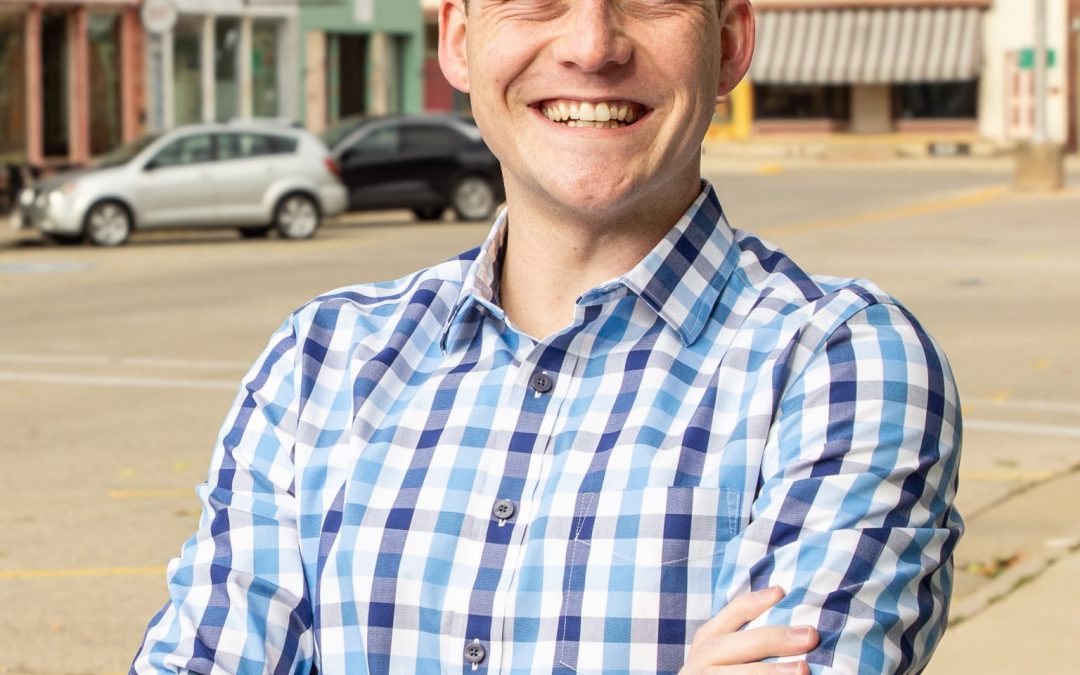
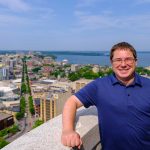
This past May, we learned that Paul Baker Prindle was named the new Gabriele Haberland Director of the Madison Museum of Contemporary Art (MMoCA). This was big news for Madison’s arts’ crowd. MMoCA has navigated some rough waters over the last several years and seems to have lost its way a little bit. Many of us are anxious to see this gem of Wisconsin’s contemporary arts scene resuming its role at the helm. I was honored to be asked by Our Lives to (re)introduce Paul Baker Prindle to our community but acknowledge I am a bit biased: I have been a fangirl of his since that long-ago night I met him at his MFA show.
I am not the only one. Paul has a whole fan club in the area, and it is comprised of the who’s who of Wisconsin artists and culturati. Paul worked at the MMoCA museum gift shop starting when he was 19. Leslie Genzler, the woman who ran that store, became like a mother to him. Before she hired him, he was living in a 1988 Grand Marquis in a mall parking lot. He told me that from the moment he sashayed into the shop, Leslie knew she was going to hire him immediately. He calls her his “transcendental mama,” explaining she was like a Mrs. Madrigal character to him at a time in his life when, it seems to me, he needed the unconditional love of family.
He finished his undergraduate degree at Edgewood College in 2004 and was fortunate to study with the prominent art historian Melanie Herzog. When Paul was still an undergraduate, Dr. Herzog and he even co-authored a paper about queer pedagogy in art history and co-presented on the topic at several conferences.
Some of Madison’s most prominent artists and faculty, Tom Jones, John Hitchcock, Jill Casid, and Michael Connors, were on Paul’s graduate school committee. David Wells, Paul’s successor at Edgewood College’s gallery, has stayed in close touch with him also. Previous MMoCA staff uniformly speak adoringly of him, and by the way, MMoCA owns three images from Paul’s Mementi Mori series. It says something about Paul’s character that the whole time he was working jobs and building a life out west, he maintained and nurtured his relationships back here.
Those of us who know and love Paul have watched him build an impressive resume that spans two decades in the art world. While completing his MFA, Paul spent periods of time in 2008 and 2009 working in New York at Gagosian Gallery and as a studio assistant to the now-deceased pioneering gay photographer, James Bidgood. [Bidgood was memorialized in the March/April 2022 issue of Our Lives.] Then in 2009, Paul got a call from artist and curator, Tracy Dietzel, asking him to throw his hat in the ring to serve as the Director at Edgewood College Gallery at a critical time when Edgewood was building The Stream and moving their exhibition program from a hallway into a proper gallery space. He was at Edgewood until he left to take a gallery director job at University of Nevada, Reno in 2013. While there, he once again helped a growing program and institution. In Reno he was responsible for establishing The John and Geraldine Lilley Museum of Art. He then spent many years as the head of the Carolyn Campagna Kleefeld Contemporary Art Museum at California State University, Long Beach, and there he once again helped establish a new facility.
And then there is Ben. You know the saying, behind every successful man…. Well, the wind beneath Paul’s wings is his beloved husband, Ben. In 2013, they registered as Domestic Partners in Madison before gay marriage was legal. Fortunately, Ben worked remotely before working remotely was a thing, so he was free to move to Reno when Paul took the position there. In 2014, when gay marriage became legal, Paul and Ben got married at Washoe County Administrative Complex, “a very sexy location,” Paul quipped.
Paul’s career has been marked by innovation as he has helped three institutions open their new gallery facilities. He has also worked in higher education settings, where fostering dialog was part of the institutional mission. He has a deep understanding of the power of art and the lived experiences of artists. And importantly, as an openly gay, Jewish man, he brings a personal understanding of oppression and the importance of including diverse voices in cultural institutions. From my informal survey, I would say that those in the community who know him continue to have great faith in his ability to not only bring back MMoCA’s reputation, but to take it to new heights. They say that even while they understand the gargantuan job he has signed up for.
Why so dramatic? Well, it is hard for an arts hag like me to believe there is anyone who is unaware of what MMoCA has gone through in the past four years, and I hate to bring it all up again, but in order to appreciate the context of what Paul has ahead of him, you need to know the backstory. This is the way I remember some major events from the last several years at MMoCA, in case you missed it:
In spring of 2020, MMoCA’s long-time director, Stephen Fleischman, retired after about 30 years. When Fleischman left MMoCA, it appeared to be shipshape. But then COVID-19 happened, and like all museums everywhere, MMoCA was hit hard. First, the museum shut its doors due to the pandemic, and while it was still in mid-pivot due to COVID, protests erupted in the wake of George Floyd’s murder. On Saturday, May 30, 2020 after the peaceful protests ended, mayhem broke out on State Street. Like many others, I watched the live reporting as the museum’s gift shop window was shattered and the store was looted.
The museum boarded up their building as soon as possible, and those boards remained over MMoCA’s storefront for many, many months. The museum reopened in August of 2020, but the store never re-opened as the museum’s then fairly new director, Christina Brungardt, decided the area the store had previously occupied would better serve the community as an interactive exhibition space, arguing that museum gift shops are the domain of wealthy white women, and she wanted to transform that space in a way that would increase public access to the museum. A worthy goal, but it did not go over very well with the community—both because many people knew and loved Leslie Genzler, MMoCA’s gift shop manager and because visiting the museum store is often part of the ritual of visiting a museum, at least for middle-class white women.
In fact, during Brungardt’s tenure in Madison, she made many controversial decisions. It was not just closing the gift shop, but Fresco, the restaurant that used to occupy the top floor, also closed. Then Brungardt decided to change the format of the museum’s Triennial, which had been relatively unchanged since it began in 1978. Under Brungardt, a decision was made to contract with a single individual curator outside of the museum. She contracted with Milwaukee gallery owner and curator, Fatima Laster.
Two months into the “Ain’t I a Woman” triennial exhibition, Lilada Gee, a beloved local artist, had her artwork destroyed by a group of unguided museum visitors. For some reason, neither the director nor the executive board could muster a genuine apology. They claimed to issue one, but the museum’s “apology” read like a bad non-apology apology joke including blame-shifting, excuse-making, and sidestepping. Nearly 100% of MMoCA staff fled. There was great turnover with the board of directors. And then on October 24, 2023, MMoCA announced that Brungardt resigned. But who could fix the damage to the institution that had occurred over the last four years?
A search began, and when it ended, Paul Baker Prindle was announced as the new director. When I heard the news, it felt like I took my first breath in years.
If Paul’s life were a Hallmark movie of the hero’s journey, his hiring would be the moment of climax in which the main character returns home, transformed by his long adventure, lessons learned, and victories won. Then the hero would use their newfound knowledge to save the village, or in Paul’s case, the museum. Before the story resolves, Paul will need to “make things right.” But Paul would not want any part of that movie that perpetuates a “capitalist hetero-masculine model of the hero coming in” and saving everyone. He wants the whole community to participate in this endeavor.
How does he plan to lead? He emphasizes the importance of hospitality: “Visitor services, development, welcoming people into the contemporary art enterprise.” Paul’s vision is for the art to reflect what is happening in the community. “With historical work we have the benefit of all the conversations and articles that have been built up over time.” Contemporary art is also in dialog with history, but mostly it is about this moment right now. “It is wreckless to have a person come into a community and foist their vision on them. My skills are in helping pull out of folks a shared sense of where we want to go and helping people apply their unique skills in getting us there.” Paul explained.
Paul and I talked for hours before I wrote this story, and we touched upon many interesting topics. Paul told me about his own artistic practice and how it has evolved and paused as he focused on other aspects of his professional and personal life. He still creates some work, but it is more for himself at this point. He even adds to the Mementi Mori series sometimes. He has also become obsessed with gardening, and he has shifted much of his creative energy into his love of plants and landscaping. Leaving behind the California yard he has poured so much into struck me as one of the losses he will experience as he transitions fully back to the Midwest.
When I asked him about his vision for MMoCA, he told me he wants to inspire openness to ideas and varying opinions. He said, “I want us to embrace our differences and build a stronger connection because of them.” He told me the main part of the Talmud is the agreement, but alternative opinions are recorded in the margins. Paul is committed to the idea of being able to hear others even when he disagrees with them. Sometimes he watches Fox News, seemingly for practice. “It is very queer to watch Fox News,” he asserted. “It is queer to hear what other people are thinking.” He concluded that chapter of our discussion by summarizing thus, “Contemporary art is the opportunity to engage robustly with the notion that there are many possible solutions.”
Then we talked about Art Fair on the Square. In spite of some wild storms that caused damage, he thinks most artists were happy and that MMoCA’s major annual event was a big success again this year. Paul tells me he has always wanted to curate an exhibition about Madison’s LGBTQ cultural legacy with objects from places like Rod’s, which was in The Hotel Washington.
Ask anyone who has known Paul what they think of him leading MMoCA, and they will likely say something positive. It is uncanny really. I have experimented with this question many times. I’ve asked dozens of people who know him. Lon Michels, for example, didn’t miss a beat before responding, “I went to graduate school with Paul. He is a free-thinking visionary with remarkable ideas. I like him very much, and I am excited for him.” He went on to say, “Paul will advance that institution and probably many more, too.” They all say some version of that same idea, that we are fortunate that Paul chose to come back home.
If they don’t know him, however, they are more likely to say, “We’ll see.” That is true. We will see. In his favor, he has deep roots here and he knows Madison audiences, our politics, and our history with racism and privilege. And not to do that whole capitalist-hetero-masculine-model-of-the-hero thing, but if anyone can untangle the tangled net MMoCA got caught up in, Paul can. If anyone can restore trust with the arts community, especially Black women artists, after MMoCA’s last couple of years, Paul can. He has a reputation as an innovator and fixer and fosterer of inclusive environments. He will bring his whole self to the job, and he is a fabulous host. I am hopeful that his appointment marks a promising new era for one of Wisconsin’s top cultural institutions.
And now, Our Lives readers, please join me in welcoming Paul Baker Prindle into this big role in our community and in wishing that he flourishes in his new postition, that he and his husband enjoy living here, that his gardens grow well, and that he brings a new era of true inclusion and peace to our cultural ecosystem.
Opinions expressed in this article are solely the author’s and do not express the views or opinions of her employer.
Karin Wolf is an arts administrator, freelance arts writer, and consultant. She likes to get deep and try to understand complex art, people, and ideas. Writing about them is her favorite way to do so. She has a M.S. in Curriculum and Instruction from the University of Wisconsin-Madison and undergraduate degrees in History, History of Cultures, and Afro-American History.












0 Comments