


|
Getting your Trinity Audio player ready...
|
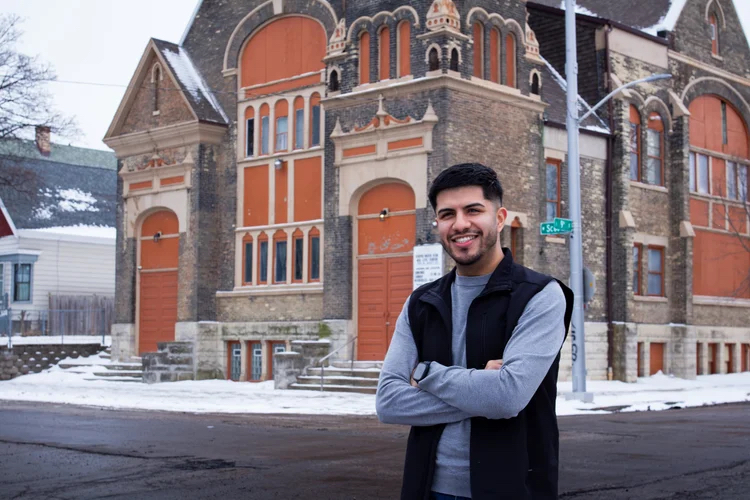
“I truly believe this district deserves leadership that listens, shows up, and fights for working families because I know the struggle,” says Ismael Luna when I ask him about why he’s running for office. “I am tired of seeing hardworking families being left behind when politicians stop paying attention.”
At 26 years old, Luna is running for Wisconsin’s 8th Assembly District, a heavily Latino district on Milwaukee’s south side. He talks about affordable housing, public safety, healthcare, and mixed-status families. He talks about community engagement and government accountability. For Luna, survival and people take precedence over politics. He has even been endorsed by Fair Wisconsin, Citizen Action of Wisconsin, Wisconsin Progress, Wisconsin Laborers’ District Council, and more. The primary is scheduled for August 11, 2026.
But to understand why those issues matter to him, it helps to understand the life he lived before politics ever entered the picture.
“I was born in Kenosha, and my family moved to the south side of Milwaukee when I was two months old,” he says. “So, it’s easier for me to say born and raised in the south side of Milwaukee.”
He grew up in a mixed-status family. His father immigrated to the United States as a young man and worked construction, and his mother stayed home to raise five children.



“I am the fourth child,” Luna says, “And my mom will tell you I was just very quiet. Never outspoken.” In fact, he says he was “mute by choice” until he was five.
Then, when he was ten, everything changed when his father was incarcerated and eventually deported to Mexico. Luna’s mother suddenly found herself raising five children alone. A few years later, Luna became the victim of sexual abuse by a family member.
“He said, ‘You are gay, therefore you’re going to enjoy this,'” he tells me.
Within the family, the abuse was never openly discussed. “When people would ask the family what happened, my mom would just say, ‘Nothing.’ I was never acknowledged,” Luna says. “For such a long time, I struggled with my identity because of that one thing. It’s still something I cope with, and that’s why mental health is a big component in my campaign.”
Today, he speaks openly about being a survivor because he knows how many others carry similar experiences.
“Oftentimes when I share that in small groups, people are like, ‘Hey, I’m also a survivor.’ And within the Latino community, we don’t talk about it.”
As difficult as those years were, things became even harder. His childhood was underscored with instability, violence, and repeated conflict at home. After his mother remarried, tensions escalated.
“Sometimes there would be physical fights,” he recalls. “My siblings and I would be fighting my stepdad because he looked at my sister the wrong way.”
Then, at fourteen, he came home from school and discovered he no longer had a place to live.
“I came home from school and my things were out,” he says. “My stepdad said, ‘You’re a grown man. You’re out of here.’ I moved in with my friend Noelia, who is now my campaign canvasser. She and her family took me in. I would also couch surf around with friends, with family friends. I would ask the community that I am now representing if they could give me bread. Jelly. Tostadas. Tortillas. Canned beans. Whatever they had, because I hadn’t eaten.”
He remembers teachers noticing what was happening and stepping in wherever they could. One teacher drove him to soccer games. After the games, the same teacher would take him directly to work at a Mexican seafood restaurant on Milwaukee’s south side.
“I remember I would tell the manager, ‘Hey, I’m just gonna throw this water on me, shower quickly, and then come back upstairs and start bussing tables.'” Everybody knew his situation, so they let him do what he needed to do.
At 16, he became a server. And at 16 and a half, he was the general manager of the restaurant doing everything from payroll and inventory to schedules.
“I understood I didn’t have the opportunity to mess up. I couldn’t act up. I couldn’t miss work. And if my grades weren’t good, it would be up to me ”
While many teenagers were figuring out who they wanted to become, Luna felt responsible for his own survival. At the same time, he was taking advanced placement classes and managed to graduate high school with honors. Still, college never felt like something meant for him.
“No one in my family has gone,” he says. “I didn’t know how to apply.”
But he had some friends attending Cardinal Stritch University, so decided to apply online.
“I didn’t know what I was doing. I was a first-generation student.”
Nevertheless, Luna found a successful way forward. While still in college, he purchased his first property. One professor was stunned.
“She asked me, ‘Do you come from money?'”
“‘No. I’ve worked hard for this,'” he replied.
After Cardinal Stritch, Luna worked as a community advocate and did a lot of work in the area of substance misuse. But he continued to have an interest in politics and eventually made his way to D.C. to attend graduate school at George Washington University.
“I saw what was going on with the Trump administration and everything. Now I have my Master’s in Public Policy, Social Policy, and Philosophy. And I’ve done internships at the State Department, I have my security clearance, I worked at the Senate, and I interned for Senator Baldwin, and at the Department of Education.”
His academic work focused on human rights.
He was interested in questions like ‘what is a human?’ And ‘why does a human have human rights?’
“People had always told me, you’re just a statistic. You don’t have a father. You’re homeless. You’re not gonna end up doing anything,” Luna tells me. “So, because of my upbringing, I didn’t understand why Ismael Luna deserved to be a homeowner. Why does Ismael deserve to be at the White House? Why does Ismael deserve to be amongst ambassadors and the Secretary of State and the Vice President?”
Today, Luna owns three properties. But success did not erase those questions he had carried since childhood. Today, they inform his work as a case manager at Cathedral Center, a women’s homeless shelter.
The work reinforces many of the lessons he learned growing up.
“For a lot of my clients, it’s all mental health. The public often misunderstand homelessness. Most people really do want to go out and work. They want to change their life around.”
The problem, he says, is that many people are navigating systems they were never taught to navigate.
“I have clients who don’t have their birth certificate. They don’t have their Social Security card. They’ve aged out of foster care.”
When people criticize those experiencing homelessness, Luna often responds with a simple comparison.
“Do you know how to file your own taxes, or do you pay someone else to do it? Most people laugh, but then they understand. A lot of people just don’t know how to navigate the system,” he says. “No one showed them.”
That same empathy shapes his political vision. I ask him whether his goal was to stay in local Wisconsin politics, or to eventually end up in national politics.
“First, I just really want to give back to my community just because my roots are here,” Luna says.
He talks often about rebuilding trust in communities where many residents feel forgotten. Among his campaign goals are funding public schools, expanding access to healthcare and mental health services, investing in drug treatment and recovery centers, and building more affordable and subsidized housing. But one of his top issues is public safety.
“The south side of Milwaukee is the dumping ground for all of the states’ issues,” he says. “There are a lot of people who are unhoused, a lot of boarded up homes, and just crime overall.”
I ask him how things might have been different if he had found himself out on the street now instead of ten years ago.
“Things are harder now because the cost of living has really risen. I have tried knocking on doors while campaigning and I’ll say, ‘Hey, if you know your neighbor, tell them I stopped by.’ But they don’t know their neighbors. It makes me feel some type of way because growing up, you knew everyone on your block. It’s hard for people to have a community or neighborhood to rely on because everyone is in survival mode now.”
Residents often look confused when he introduces himself. Some tell him they have never had a candidate visit them. Others wonder whether voting matters at all.
“They’re like, ‘Why should I even vote? My vote doesn’t matter. Nothing changes.'”
Luna believes change begins with showing up, listening, and educating people on what resources are available for people in his community.
His campaign organizes neighborhood cleanup events throughout the district. These events allow people to see him, his campaign staff, and community members doing something tangible to improve life in the community while giving him a chance to talk to people about what he’s trying to do.
“We started off with five people,” he says. “Now we have up to twenty-five people who show up.”
It seems to be more about community building than anything else. And perhaps that is why, when asked about his long-term goals, Luna doesn’t mention higher office. Instead, he talks about belonging.
“My motto for my campaign is that I want to be invited to the carne asadas, to the cookouts.”
He laughs, then he explains what he means.
“I want people to know who I am and know my story.”
Because he remembers what it meant when his own community showed up for him. And because after everything he survived, he believes government should do the same.













0 Comments