


|
Getting your Trinity Audio player ready...
|
“Act more like Cher!!” screamed the crowd. The Cher medley lip-synced by men in black wigs and short sleeveless sequined dresses was four minutes longer than the attention span of the drunken hecklers. Drag shows had become a staple at the Fairy Prairie gatherings during the zenith years when up to 35 men camped out on my land for a weekend jamboree of fun, laughter, food, drinking, hikes, swimming, and sex. The stage was the front porch of the cabin as well as the brick walkway leading up to the front door. Music blasted on the porch, and headlights from a car parked in the yard acted as floodlights for a variety of acts: The above mentioned Cher Medley; Queen Latifa lip-syncing, “When You’re Good To Mama, Mama’s Good to You” while sporting more than ample boobs with twirling gold tassels; a hillbilly star Kitty Wells singing the refrain, “Flee the downward path kindle not his wrath or he’ll set your fields on fire;” a trenchcoated flasher doing a perverted rendition of Lili Marlene: A famous Marlene Dietrich and WWI song with the love object being, “mein große schvantz,” which was just a huge dildo flopping out of a trenchcoat.
One particularly popular number consisted of a duo in Hawaiian grass skirts, hips swaying while sporting coconut bras and lip-syncing Israel Kamakawiwo’ole’s iconic Hawaiian version of Somewhere Over the Rainbow. They were flanked by tiki torches, mock plastic Easter Island Figure Heads, and two gorgeous muscle men sporting loin cloths.
One of the raunchier acts consisted of a pregnant hillbilly in a wedding dress who assumed a Lamaze position and birthed a pig on the picnic table in front of the cabin while singing an old bluegrass tune.




Fairy Prairie’s Humble Origins
The gatherings started in the early days when there was just the tipi. Three to five gay friends of mine would come out for a weekend every summer. It stayed a rather tame and intimate affair until the cabin was built. Water was hauled from a neighbor’s spring, lights were kerosene lanterns, the bathroom was an outhouse, and the kitchen an outdoor area with a Weber grill, a Coleman cook stove, and coolers filled with ice.
Being only 4.5 miles east of Ferryville, a rivertown on the Mississippi River where before the Blackhawk Bridge was built in 1931 a ferry connected Wisconsin to Lansing Iowa, it was a no-brainer to name the land with its prairie restoration project, Fairy Prairie. I embellished this double entendre by telling people Fairy Prairie was between Ferryville and Gays Mills. Gays Mills was to the east and was located on the Kickapoo River. The dam and associated mill that was located there to process grains in the early 1900s, was owned and run by the Gays brothers. The name Fairy Prairie was also paying homage to the Radical Fairies. This group, which was founded in 1979 by activist Harry Hay, arose out of the liberation movement of the 70s and reclaimed the derogatory term Fairy and owned it as a source of pride. The group was a decentralized, counterculture spiritual movement for queer people. Its goal was to explore a deeper, nature-based spirituality beyond mainstream gay liberation. It incorporated elements of paganism, anarchism, and environmentalism. Gender fluidity and community were other founding principles. They held radical fairies’ gatherings throughout rural America that provided safe spaces to find community. I was familiar with them through subscribing to their quarterly newsletter RFD, so named because of the post office policy of rural free delivery in the early 1900’s.
Hosting a Support Group Leads to Friendship
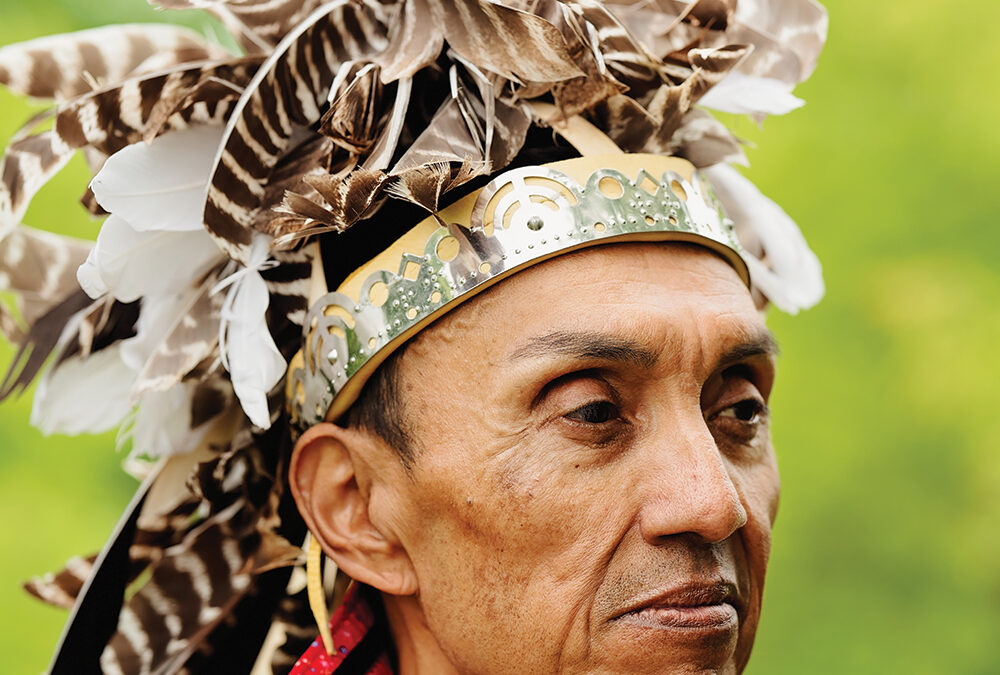
Queer gatherings at Fairy Prairie started to gather steam when a support group from the Milwaukee AIDS Project led by an Ojibwe facilitator started having annual healing sweats there. By then I had a one room cabin although the lack of infrastructure remained the same. The first year they went into the woods above the cabin and cut aspen saplings to be used in constructing the sweat lodge. I wanted those removed anyway as part of restoring that area into an open oak woodland, so their efforts helped me as well. They built the lodge by bending the saplings into a half dome structure about 12 feet in diameter. It was then covered with multiple layers of blankets. It was situated along the banks of Sugar Creek, the cool trout stream traversing the land and below a bird-shaped effigy mound constructed by the Ho-Chunk people who colonized the driftless between 800 and 1300 AD. The settlement associated with the mound was across the stream and county road where a fourth-generation Norwegian farmer lived at the time.
After a week of ceremony, making strings of spirit figures, and hydration, the sweat was held. Carefully selected stones 6 to 8 inches in diameter were placed on a huge pile of burning oak logs. The sweat consisted of 12 rounds. For the first round, one sparkling, glowing red-hot stone was brought into the lodge and placed in its center pit. For the second round, two stones were brought in, for the third, three stones, and so on until finally 12 stones were brought in. Participants told of heat so intense they would lie on the dirt floor rubbing cool mud on their faces.
I was honored to have this activity occur on Fairy Prairie, and we all became good friends as the sweat became an annual event. When the group broke apart after about four years, most of the participants still wanted to visit every summer. Add to that group a few of my friends, both local and from Milwaukee, and the tradition of an annual gay gathering began at Fairy Prairie.
Displays of Pride
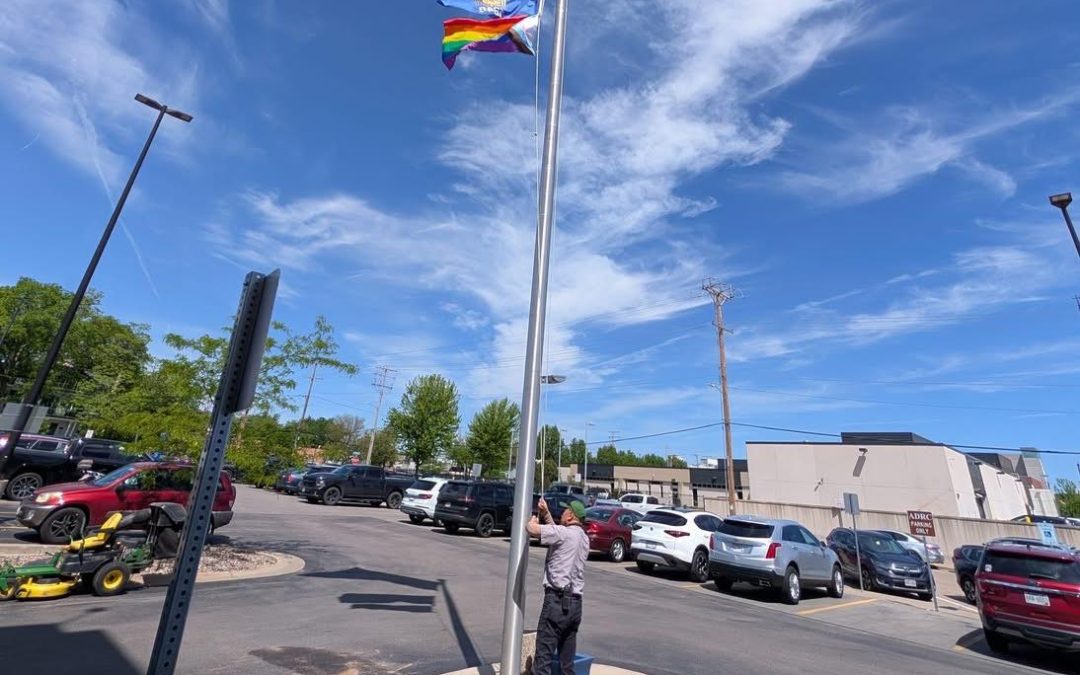
Given that the cabin was up a winding quarter-mile gravel driveway, I marked the entrance on County Trunk C with a large rainbow windsock. Not only did that mark the entrance for revelers, it also was a way of expressing pride. Although many locals were reasonably accepting of gay men, homophobia was far from absent, so a public statement of pride seemed necessary. In addition, I took an old tipi pole and nailed it to the farmer panel where the power hook up was for the cabin and put a gay pride flag on its top. For the next 30 years, that flag and its replacements, when weather and wind rendered it tattered and torn, overlooked the cabin and yard, marking the space as a queer haven.
With the cabin at that point just being one room it was a camping event with tents set up in the yard or down by the creek. Meals were a communal potluck affair. I never had to worry about food. Participants never failed to bring more than enough great dishes to pass and share. Mealtimes were when everybody was together, sharing, building community and forging new friendships. Back then the wood-fired hot tub was located down by the creek, so much of the social activity was located there. Spontaneity was the rule, and one could never predict what would happen next. One year what I assumed were two very stoned men embarked on a free form Twyla Tharp-like dance performance. It was beautiful, organic, and free form. One of the participants went on to start a dance company, the other still talks of it 30 years later as one of his favorite artistic moments.
There was nude swimming and sunbathing by day, hot tubbing and lots of sex by night. One year, the afternoon agenda was spiced up by a nude raft race down the creek with the participants floating on pink and orange flotation devices from Walmart. The dozen or so participants were cheered on by a gallery of men screaming and laughing their way along the banks, cocktails in hand.
The lighting of a huge 12-foot-high bonfire was a tradition. I spent decades clearing boxelder trees from along Sugar Creek, so every year there was a bonfire that shot dancing tongues of flames twenty feet or more into the night sky. Dancing, uproarious laughter, shouting, and mooning of the fire all ensued. Yes, we mooned the fire. Although everybody began thinking it was strange and possibly uncomfortable, the fact is that dropping your pants, bending over with your buttocks facing the fire and slowly moving in as close as was comfortable felt sooo good that nobody resisted doing it a second time. The warmth of the fire on your bare buttocks was soothing in a way that truly shocked everybody. At least once each bonfire, a line of bare arses would circumvent the flames, and joyous laughter would echo across the valley.
Improvements to the Cabin
A few years in, electricity, a well, and a bedroom were added to the cabin, so the hot tub was moved to the yard. Moving the tub was a task that required a lot of people, so I had saved this job for a Fairy Prairie weekend. Gay boys love a manly task, so 10 of them circled the tub and lifted it onto a trailer while 20 more cheered them on with cocktails in hand. The only vehicle that had a trailer hitch that fit the ball of the trailer was a buddy’s Lexus, a very meticulous Lexus owner at that. We pulled it off flawlessly, thus one of the epicenters of activity became closer to the cabin. Men soaking in the tub was now part of the view as one looked out over the yard, toward the prairie to the north and hills beyond. It was a wood-fired tub, with a submersed wood stove occupying a quarter of the space, so I was always tending to its various needs. Heating it up, then keeping the water level constant with a hose and regulating the temperature. There were always two-to-five guys in it along with some sitting around the tub, drinking and rotating in and out. Most years, the bonfire was by the creek where the tree clearing was going on, but some years I did enough clearing near the cabin that a second bonfire was in the yard by the cabin.
Fairy Prairie Goes Regional
As the years progressed, and word got out, people from La Crosse, Madison, and Chicago started showing up. Some I knew, and of those I didn’t, many eventually became friends. It was during the zenith years when 30 to 40 guys showed up that the drag shows became a staple of the Saturday night lineup. The tote full of drag costumes was kept on the front porch all weekend so Saturday afternoons, before or after creek time, groups of men gathered in the yard in front of the cabin and sat in the sun, laughing, eating, drinking, and wearing whatever they decided to grab from the bin of drag paraphernalia. A string of pearls here, a skirt or sundress there highlighted with the occasional coconut bra, pink boa, wig, or pair of high heels. Mixed with various degrees of nudity, thongs, and body types, it made for a visual potpourri that embodied the free spirit of Fairy Prairie and demanded a smile.
Although in general this was a BYOB affair, I provided a lubricant to either get things going during evening cocktail hour, or in the case of Saturday afternoon, to bite the hair of the dog. In another double entendre my Queen of the Prairie punch, which was so named for myself, the de facto Queen of the Prairie, as well a beautiful prairie plant by the same name that showed off its cotton candy style plum of brilliant fuchsia pink flowers in mid-July.
An Idyllic Natural Setting
The setting of the cabin was idyllic to say the least. The main valley that Sugar Creek ran through ran east and west. The morning sun illuminated the dew drops from the night before on the prairie like thousands of sparkling crystals. The golden evening summer light shown across the valley and illuminated the elderly cottonwood trees lining Sugar Creek mimicking huge green, billowing, cumulus clouds. At night the moonlit prairie’s soundtrack was a cacophony of either frogs or crickets and katydids, depending on the season. Sugar Creek traversed the property and ran swift. Its spring-fed waters were cool and refreshing. Multiple swimming holes up to 6 feet deep were scattered along its course, making hot summer days a delight rather than something to bear.
Fairy Prairie gatherings were not only festivals of gay pride, they also presented an opportunity to be immersed in nature. Walks through the woods where logging trails were kept open and mowed involved hiking up the steep 300-foot hillsides to the bluff tops overlooking the valley. I tried to time the gathering with the prairie’s peak bloom from late July through early August. I delighted in conducting evening walks through the prairie, when, with cocktails and joints in hand, my guests received a lecture of where the restoration project was to date, what was planned in the future, and a quick course in botany as I identified species of prairie plants and told each one’s story as to how they came to be there, where the seeds came from, and how long it took for them to become established.
Although the majority of people slept in tents, some stayed in the tipi, and for a few years we had an RV crowd complete with the obligatory rainbow-covered lights strung up across the drop-down awning.
One year my partner Jack designed a t-shirt with a bonfire, tipi, and dancing figures—inspired by those on the side of the tipi—on a sky-blue background. It was a great design, and a great memento for all involved. I still have mine 30 years later; I’m not wearing it or washing it to preserve this artifact of Fairy Prairie’s glory days.
Star Valley Cave Crawl
For a few years, I led a group of interested partygoers into a local cave. Star Valley cave was located on private land a 10-minute drive away. Its entrance was a two-foot-high slit at the bottom of a 5-foot-deep hole. It was a very dramatic entrance and the ten yards one had to crawl on hands and knees before the cave opened up, made for quite the adrenaline rush, especially for first-timers. It added an adventurous, butch activity to the weekend that was frightening enough to be fun and left those involved feeling like spelunkers at the end of the day.
Fairy Prairie was a Bacchanalian event full of copious amounts of food, pot, alcohol, and sex. Years later when talking with attendees, I’ve heard of who had sex with whom and where. I think it’s safe to say that my partner Jack and I were the only two people not involved with these frolics in the prairie, woods, hot tub, and tents. I was a bit inhibited sexually in those days and besides, I assumed that Jack would be upset if I engaged in these activities. It is only recently in talking with him that we both realized we would have been more than happy had the rules of our relationship been suspended once a year for three days!
Slowing the Pace & Continuing to Hold Space
As we aged the festival dwindled. Sleeping in a tent became less attractive and young newcomers became scarcer, making it less exciting for the old timers! Nevertheless, gatherings of friends of a smaller nature continued to be a staple at Fairy Prairie. For a couple years, I even hosted a lesbian weekend organized by my Milwaukee girls. “Pussy’s Galore” had its own signature dark purple baseball cap with the silhouette of a black cat on the front. That event also deserved a proud announcement, so by the driveway entrance there was a windsock of the same design. The local gay boys, who numbered about a dozen, helped Fairy Prairie maintain its queer mojo by coming down most summers for a potluck and evening of bonfires and hot tubs. The tradition didn’t completely die. Fairy Prairie remained an affirming space.
Gatherings of friends are fun and necessary for everyone, but for me and most in my generation, gatherings of gay men had a special significance. The explosion of the gay rights movement post-Stonewall released a whole generation from homophobia and oppression. We formed our own world which, although centered on the gay bars, also extended to all walks of life. For decades, my entire social world involved queer people and queer spaces. I had had enough of straight people, and even though many had become advocates and allies of queer folks, being in a space, in a world, where all fears of homophobia were absent, and acceptance was guaranteed, was intoxicating.
Fairy Prairie Gatherings provided a weekend free of any judgement or restraints imposed by the straight world. In addition, the setting provided an experience immersed in the serenity, beauty, and magic of the Driftless, or The Shire, as the local gay boys called it. Companionship, affirmation, frivolity, laughter, debauchery, connection with the natural world; these were the fruits of this heartfelt tradition.
All these decades later, whenever I meet someone who had been involved with the gatherings, I am surprised to hear what a meaningful and important experience it was for them. Looking back, what an honor it was for me to have been able to hold this space.














0 Comments