

|
Getting your Trinity Audio player ready...
|
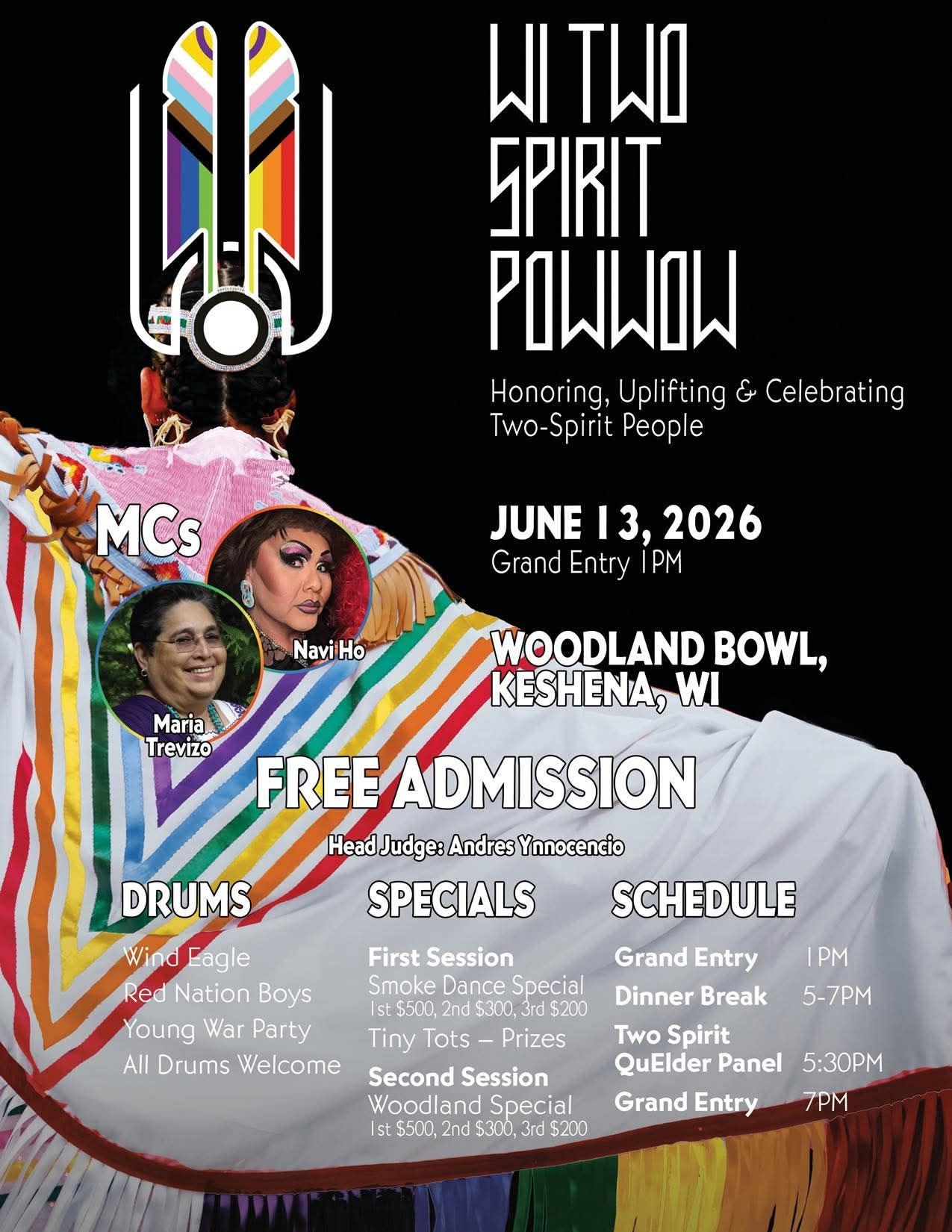
In mid-June, something unprecedented will happen in Wisconsin.
For the first time, Two-Spirit people from across the state will gather on powwow grounds as the center of the circle rather than as a category squeezed into binaries. Organized by Leslie Doxtater and a growing coalition of Indigenous community members, the Wisconsin Two-Spirit Powwow marks a historic first: a space built intentionally for those whose identities have long existed, even when the language to describe them has not.
But to understand why this moment matters, you have to start with a word that resists easy definition.
A Term That Holds Many Meanings
The term “Two-Spirit” is often misunderstood, especially outside of Indigenous communities. It is a translation of the Ojibwe (Anishinaabe) term niizh manidoowag, which activists chose to adopt as a pan-Indian label to describe queer identity at a conference in Manitoba in 1990. But the term was never meant to flatten identity into a single definition. As Doxtater explains, it was created as a kind of bridge.



“It was an umbrella term for tribes to use that don’t have terms already within their language,” Doxtater said, meaning that some tribes may have lost their language to describe queer experiences as a result of colonization. For others, the use of the term “Two-Spirit” can describe something else, such as the role of a person to exist beyond the confines of defined gender binaries, or other experiences.
“It is really a hard term to define for people that are a part of a tribal community,” Doxtater says. “And so, it’s even harder to explain to somebody that’s outside the tribe.”
Unlike Western LGBTQ+ labels, which tend to separate gender and sexuality, Two-Spirit identity is rooted in cultural roles. Historically, Two-Spirit people often held specific responsibilities within their communities that could encompass both masculine and feminine perspectives, or something entirely different.
“They were recognized as a Two-Spirit person who could see their role in community from both lenses,” Doxtater explains. But the term is not interchangeable with “queer,” nor is it available for general use.
In recent years, many non-Indigenous people have mistakenly adopted “Two-Spirit” as a personal identity label. Within Native communities, this is widely understood as misappropriation.
“It’s specifically Indigenous,” Doxtater stated plainly.
The Rise of “Indigi-Queer”
Partly in response to that confusion and appropriation, another term has gained traction in recent years: “Indigi-queer,” which Doxtater explains is more approachable for many people.
While interpretations vary, she describes a key distinction: Two-Spirit is often connected to traditional gender roles within cultural and ceremonial contexts, while Indigi-queer more commonly refers to sexuality and identity in a broader, often more urban Indigenous experience.
“The term is specifically around sexuality,” she says. “Probably somebody that doesn’t necessarily identify with the tribal practices as much.”
It’s important to note that in this interpretation, the term Indigi-queer functions differently than most common usages of the Western umbrella term “queer,” which is often not strictly referring to just a person’s sexual orientation.
The term also serves a practical purpose. “The other reason I think they went with Indigi-queer was because a lot of non-Native people were trying to identify with the Two-Spirit label,” Doxtater says. “When you put Indigenous in front of things, they aren’t trying to take it anymore.”
For some, the word functions as both an identity and a boundary. It is a way to claim space while making clear who that space is for. Still, the lines between the terms are not rigid. Doxtater herself embraces both.
“I would also identify as Indigi-queer,” she says. “I think anybody that’s Two-Spirit has that capability.”
An Idea Sparked
The Two-Spirit Powwow itself began with a question. Why doesn’t Wisconsin have one?
Doxtater remembers the moment vividly. She had traveled to a Pride event organized by the Menominee Nation community, bringing posters that highlighted Two-Spirit people throughout history, each one underscored with the simple message, “We’ve always been here.”
After speaking, an elder approached her.
“Why doesn’t Wisconsin have a Two-Spirit powwow?” they asked.
“I was like, I don’t know,” Doxtater recalled. “Why doesn’t Wisconsin have a Two-Spirit powwow?”
Within days, the idea had momentum. A team began to form, and a sponsor stepped forward to pay the $400 it would take to rent the Woodland Bowl on the Menominee Reservation.
“I was like, okay, so we’re really doing this,” Doxtater laughed.
From there, the process was equal parts improvisation and determination. Doxtater, who joked that she’s “not a powwow person” and usually attends “for the food,” threw herself into learning everything she could about event logistics and cultural protocols. She even ended up taking a last-minute trip to Minneapolis, where several Two-Spirit powwows have been held in recent years.
Reimagining the Powwow Circle
To understand what makes this powwow unique, it would help to understand how most powwows operate.
Powwows are, first and foremost, social gatherings. Often, they are held in honor of certain holidays, families, or events, but they can also function more simply as celebrations of culture featuring music, dancing, art, food, and fashion (both as traditional dance regalia and as people showing up dressed to impress). Across the country, many powwows include an aspect of competition in which dancers are categorized, often strictly, by gender and style. Judges award placements, and prize money can be significant. But that structure can create barriers.
“In a lot of cases…Two-Spirit people don’t really dance in competition powwows,” Doxtater said. “Or they will, but they typically won’t place.”
Even when Two-Spirit dancers are allowed to compete, bias can shape outcomes.
“If they know that this is a trans person, most of the time they will allow them to dance, but they won’t place them, ever,” she says. “Even if they are a good dancer.”
That exclusion is not always explicit, but it is deeply felt. The Wisconsin Two-Spirit Powwow plans to take a different approach.
“We’re going to do all intertribals,” Doxtater explained. “So that means anybody can come dance any style that they would like. And everybody is included.”
The event will emphasize participation, community, and ceremony over competition, though there will still be prizes for the dancers to win. In many ways, this shift from competition to community centers the space in ideas that are both more innovative and more traditional:
“As far as being an Indigenous person dancing, you dance for the creator,” Doxtater said. “It’s really to bring joy to the creator.”
Tradition, Adaptation, and Self-Expression
Powwows are often rich with visual and cultural expression: regalia, music, movement, and food all carry meaning.
Dancers, or members of their family or community, typically create their own regalia, reflecting both personal identity and tribal tradition. Some styles are deeply specific and tied to particular nations or regions. For example, the Two-Spirit Powwow will include a smoke dance special, a dance form rooted in Haudenosaunee culture, as well as a woodland-style special connected to Menominee and Anishinaabe traditions.
For Two-Spirit dancers, regalia can be a unique opportunity for innovation. In her work, she has helped community members design clothing that aligns with their identity—like ribbon pants or shorts for those who don’t feel comfortable in traditionally gendered ribbon skirts or shirts.
“We’re working on it,” Doxtater said, when asked whether nonbinary-specific dance styles exist. “Honestly.”
A Space for Learning and Being Seen
Beyond dancing, the powwow will include vendors, food, and community resources, all hallmarks of powwow culture. Attendees can expect everything from handmade art to fry bread, as well as tables from organizations offering support to LGBTQ+ individuals.
But one of the most significant elements will take place during the dinner break. Between sessions, the event will host a panel of Two-Spirit elders, what Doxtater affectionately calls “Quelders.”
“They’re going to share some of their life experiences,” she said. “And you aren’t going to get that anywhere else.”
The first-of-its-kind panel, supported by the Wisconsin Indian Education Association, aims to create a public, intergenerational conversation about Two-Spirit identity in Wisconsin.
“It has been really hard to get anybody over my age to want to engage in activism,” she said. “They’re closeted, but not closeted.”
By creating space for elders to speak openly, recording the panel, and sharing and archiving the footage, the powwow hopes to become something more significant than a one-day event.
Why this Moment Matters
More than just a cultural milestone, Wisconsin’s first Two-Spirit powwow is a response to a long-felt absence of visibility, of resources, and recognition.
“There’s a whole lot of the queer community who don’t know what we’re about,” Doxtater said. “Even a lot of the queer community itself here doesn’t know about Two-Spirit people.”
That lack of awareness extends within Indigenous communities as well, particularly for those living in urban areas or disconnected from tribal traditions, and this powwow seeks to bridge those gaps. For young people questioning their identity, it offers representation. For elders, it offers recognition. For allies, Native and non-Native alike, it offers an invitation to learn.
And yes, non-Native people are welcome.
“It’s not just for Two-Spirit people,” Doxtater says. “But for people who also support.”
That openness is intentional, but it comes with responsibility: Visitors are stepping into a space that is not theirs, but that they are invited to witness and participate in with respect.
Looking Ahead
If successful, Doxtater hopes the powwow will not remain in one place.
“My hopes for the future is that it won’t stay at Menominee,” she said. “That we can actually rotate it through reservations.”
For now, though, the focus is on creating a space where, for once, Two-Spirit people are not navigating the margins of tradition, but shaping it.
“There’s never been this many queer people on a powwow grounds at one time here,” Doxtater noted. And while that alone would be historic, she has also been getting word of more and more interest from people out of state who plan to attend.
But the deeper significance lies in the possibilities for the future. This powwow opens the doors for finally reclaiming and giving voice to so many stories that were never gone, merely hidden.
As Doxtater’s posters declare: “We’ve always been here.”
On June 13, Wisconsin will see that truth made visible.







I WISH I could make it to this!! Sounds absolutely fantastic <3