


|
Getting your Trinity Audio player ready...
|
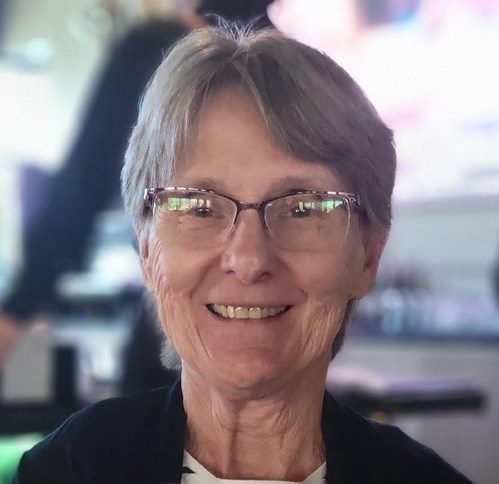
Lifelong Wisconsin resident Denise Jess (she/her) has spent her time fighting against homophobia, ableism, and separatists. She has run into various professional and personal challenges as both a self-identified lesbian and blind person: “I have some functional vision, but not a lot.” Nevertheless, today she serves as the Executive Director of the Wisconsin Council of the Blind and Visually Impaired (“the Council”) where she makes sure her decision making is informed by all the lessons she has learned along the way.
During our 40-minute conversation, it was very apparent that Jess is a force to be reckoned with; her vulnerability and earnestness shined throughout our discussion.
Beginnings
Jess grew up in Door County on a 35-square-mile spit of land called Washington Island. From there she moved to Madison at 18 years old to attend the University of Wisconsin where she was initially drawn to both writing and meteorology. But it was 1981, and Jess found that, “neither the science nor the journalism world was really prepared for a blind student. While I don’t mind dealing with barriers, there were going to be so many that I was like, ‘The juice isn’t going to be worth the squeeze.’”
Despite being disappointed, Jess continued pursuing a degree and shifted her focus towards elementary education with an emphasis on special education, noting that she “really wanted to help kids open up doors of opportunity that had been closed.”
She student taught at the Wingra School, but upon graduation struggled to find employment. “Folks would say I interviewed really well. They loved me, but because I’m a non-driver, they didn’t know how I was going to get to and from work. I’m like, ‘I have that worked out, I’ve been doing the blind thing my whole life.’ I have strategies, but I faced just so much unconscious bias.”
Eventually the Wingra School brought Jess back as a co-teacher in 1985 and later promoted her to head teacher. It was during her work at Wingra that Jess, at 24 years old, came out as a lesbian. At the time, she had been volunteering with Dane County Advocates for Battered Women, now DAIS (Domestic Abuse Intervention Services). The other participants in the organization served as positive role models and mentors for Jess in navigating her lesbian identity, although this joy at times felt like a double-edged sword.
“Coming out, I felt like I got a lot of support, but there was a lot of not seeing me also as a person with a disability. One dimension of my identity was really honored in the community, but another dimension of disability was just not talked about…There was more space for women using mobility devices and wheelchairs than the needs of those of us with vision loss; I would almost call it a hierarchy ranking. So, these needs for these people with disabilities are more important than these needs for these people with disabilities. It was an uncomfortable, awkward time to navigate being so jubilant about being out and being held in community and also not having my full identity really honored,” explained Jess.
Changing Tides
After almost a decade at Wingra, Jess decided to take a swing at something new and ran a sole proprietor consulting practice, which she did for 22 years. The work was focused on, “knowing the skills of being a worker: the human interaction skills such as the ability to work through conflict, have difficult conversations that are meaningful, understand the different ways we show up in the world, creating space for that and not asking people to assimilate.”
Additionally, she started teaching classes ad hoc at the University of Wisconsin until 2016, when she finally became Executive Director of the Council.
What follows is our Q&A with Jess:
How long were you a board member before being Executive Director?
I was on the board for under two years before becoming ED. I had been a little apprehensive to get involved with the organization, because the blindness community really siloed itself from the community at large and from other disability communities. Both as a lesbian and as a human, I’m not into separatist culture, and that was a hot topic when I was a young. I enjoy the challenges of interacting with people who are not like me and who are like me.
I reached out at the Council a couple of times, and found them back in time to be very, very, very separatist. As someone who has a little bit of sight, I got the message that I wasn’t blind enough. So, there have been some painful points.
I remember one day I was teaching a workshop on conflict transformation. I always start workshops by letting folks know who I am and doing my brief bio, and then letting them know that I’m legally blind, so I won’t see their raised hands. I say, “I’ll pause frequently, but when you have questions, just say my name, and I’ll check in. This is how to get my attention.”
When we went around the circle and people were introducing themselves, this one man said, “I’m so grateful for what you said. I also am going blind, and this is just comforting to me to know someone else is in the room—someone with a lot of ease and confidence.”
At the first break he came up and said, “I’m the new incoming president for the Wisconsin Council of the Blind and Visually Impaired Board. Would you consider joining our board?”
I said, “I gotta think about it because I don’t have the most positive history with them, so, let’s talk.”
I had a really good conversation with him and decided to step forward. I was on the board for just under two years, and then my predecessor was getting ready to retire. She asked if I would consider throwing my hat in the ring. I really appreciated her. I’d known her for years in other contexts, so I decided to give it a go.
How did the Council come into being?
When the organization was formed in 1952, its original mission was advocacy in the state legislature. The founders were folks who were blind and understood those institutional barriers. Then over time, the vision services and education mission were added.
When I joined the Council, the advocacy piece was still part of the mission, but it needed a booster shot, which was really exciting to me—to help really reinvigorate public policy and advocacy and to build a lot of coalition work. We’re members of the Wisconsin Disability Voting Coalition and other coalitions around the state where we have common ground with folks. The blindness world was very siloed for a long time, and when I came into my seat it was very siloed, not interacting so much with other disability groups, or other groups in general. So I wanted us to de-silo ourselves.
I’m really proud of the work that we’ve done together over the last nine years—de-siloing the organization, interacting across disability, finding our common ground, and lifting up each other’s issues. Particularly now, we really need that. Then increasing the footprint of the Council’s visibility: When our sighted community sees us as positive and contributing and as people with a lot of life force, that helps break down those stereotypes and those biases that folks have after maybe reading about blindness. So often, the narrative about blindness is Helen Keller. I’m like, “Oh it’s that and so much more.” We have been on a trajectory of increased visibility and I’m really, really proud of that.
What kinds of fundraisers does the Council have?
We have a White Cane Campaign. One of the things that I have loved about this organization is that even before we were incorporated, the folks who were thinking about moving us in that direction wanted to make sure they could put a white cane into the hands of anyone in Wisconsin who needed them for free.
The cane is such an important tool for independence, mobility, and self-confidence; knowing how to use your cane is liberating, because for so many folks who don’t use a cane or are losing their sight, the world is a terrifying place. There’s a lot of noise, there are a lot of obstacles, even in familiar spaces, both indoors and out. So, without a white cane in your hand and learning how to use it, people often stay home, which is incredibly painful to me, or they only go out when they can be on the arm of someone they trust.
Our forefathers and foremothers recognized that the cane was liberation, so that campaign is something I’m so proud of. We still receive funding from our generous donors to be able to do that: To put a cane in someone’s hand for free. And they can replace that cane every two years. For our kiddos, we replace them sooner than that because they grow so quickly and because they are really hard on canes. Sometimes they use it like a pogo stick—just hilarious. So, that’s one of our most important campaigns.
We have small fundraisers that run throughout the year, and our end-of-the-year one is big. Those are all still old-fashioned mailed letters and email campaigns. We have donors that have been with us for 35–40 years. We have a really high donor retention rate about 62–63% and the industry standard is about 40%.
We’re also proud members of Community Shares of Wisconsin and participate in The Big Share every year, as well as workplace giving. Dining in the Dark is primarily an education event, but it does have a bit of a fundraising turn to it as well, because people pay for their dinner ticket. Our restaurant hosts are often very generous with what their expenses are so that we can have a bit of a walk away—it might be under $1000, but it all goes together in the pot to make things work.
What big changes have you seen in your decade with the organization?
Some of the biggest changes that I’ve seen are that shift in attitude of the board and staff—and the Wisconsin blindness community in general—to reach out, to connect with other groups and to connect with each other. There was a lot of territorialism, and I thought, “Wait, why are we doing that?” I’m really proud to be a leader in those groups and to have people coming together for the greater good, instead of a “Who took my cheese?” attitude. That’s super exciting to me.
Our society is still so deeply rooted in ableism, and it’s often an untalked about form of oppression. Even when I came here, there was still some discomfort about naming ableism as it is. I say, let’s call it what it is. I’m seeing a shift there and a deepening understanding of how the challenges that people who are blind and low-vision face fit into a system of oppression and that dismantling is beneficial to everybody. That is a really powerful shift in intersectionality.
I basically said to the board chair when I was offered the position, “I’m not going back in the closet as a lesbian. I’m out, I’m proud, and I’ve been married for a long time. I’ve got daughters. You get what you get.” I sensed there was some pretty significant homophobia in the blindness community, and we’ve made a really positive shift there of creating space for intersectionality; that is just so incredibly critical.”










0 Comments