


|
Getting your Trinity Audio player ready...
|
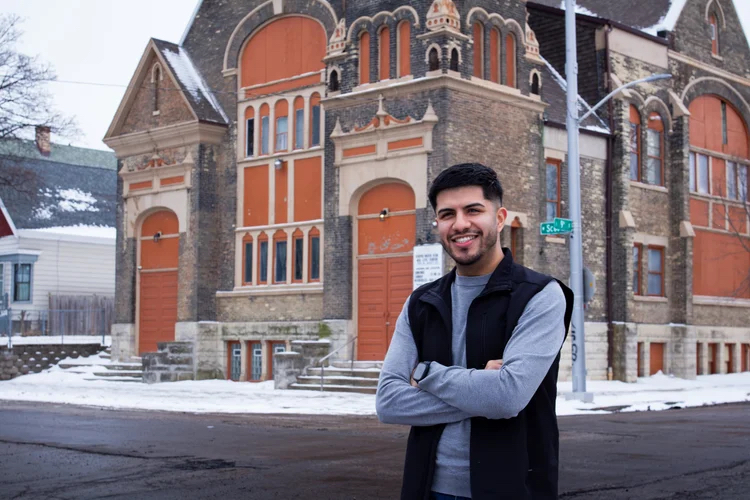
I met with Dr. Fernie at their bespoke loft decorated in Talavera pottery in downtown Madison. The windows and balcony give stunning views of the city and the Wisconsin State Capitol. The space has become a semi-sanctuary for Fernie, who has a very public-facing and demanding role. To relax since their January 2024 roller coaster move from Minneapolis, they love to enjoy Mother Nature by observing the clouds (especially when storms roll in) and tending to their potted plants.
Despite having never met prior, Fernie was truly an open book throughout our 90-minute conversation.
Pandemic Pandemonium
Over the last 15 years, Fernie worked for four Minnesota-based higher education institutions, culminating in their 2019 hire as Director of the University of Minnesota’s Multicultural Center for Academic Excellence. Although they enjoyed that position, they experienced a lot of turmoil having had the COVID-19 pandemic begin during their second semester after hire, followed by the murder of George Floyd right there in Minneapolis.
Additionally, the pandemic served as a time of soul searching and discovery for Fernie, as it allowed them to process their gender identity. Despite having put on makeup and dressing in feminine clothes occasionally as an undergraduate, it was only in 2020 with someone whom they were dating who asked, “Would you ever dress up for me?” that suddenly made them realize there was more to it for them.



“Every time I would look in the mirror over the course of my life I saw a girl—every time!” Fernie exclaimed. “I would look and I would be like, ‘I’m a girl.’ They’re just fleeting moments, but there are many,” explained Fernie. “I’ve been accessing her in different ways. In situations or moments, like on Halloween when I would have that ‘Oh my god!’ feeling and then always having to put her away. The turning point was in 2020 when I got connected to a good therapist and started asking some really important questions.”
The struggle was so deeply entrenched in Fernie’s psyche that they even incorporated gender and sexuality into their academic pursuits. In 2018 they received their Ph.D. from the University of Minnesota. Their dissertation was entitled Borderland Masculinities in Higher Education and focused on unpacking masculinity with six first-gen, gay Latino men.
Dr. Fernie recalled one poignant moment during the research process where they sat across from one of the guys and asked, “What does your college degree mean to you?” The subject responded, “My college education is my apology to my family for being gay.” The two, seated at Starbucks, both ended up in tears. They recalled almost falling out of their seats and wondering, “Fernie how long have you been apologizing? And how long are you going to continue to apologize?”
Despite this, Fernie remembers still being unable to tap into their femininity and instead focusing on the next big thing e.g. the position at the Multicultural Center.
“As soon as I broke my masculinity, I realized all of this indebtedness to cultural expectations, gender norms, guilt of being first gen—all of this indebtedness that was wrapped up into my being a man suddenly was gone. The pandemic forced me to stop, and finally, as I realized my transness, I started also understanding, ‘Oh gosh, this is why I have been self-harming. This is why I have been abusing alcohol. I have been literally doing everything possible to keep this [a secret!],’” Fernie said.
Family of Origin
Fernie grew up in El Paso, Texas with parents who married and divorced each other twice. Their father immigrated from Juarez, a city in Mexico separated from El Paso by practically just the Rio Grande and Border Patrol. However, after the second divorce, their father told Fernie’s mom, “Keep your house and keep your kids.” Thus, the two have not spoken in over a decade, and Fernie is unsure if he’s even aware of their transition.
“What tipped it over for me was his toxic masculinity continuing to destroy and harm the family,” they explained. They gave the example of their brother coming out as a gay man and being kicked out of the home. This turned out to be a defining moment for Fernie, who would eventually come out as bisexual, gay, and then transfeminine.
Fearful of being kicked out if anyone knew about their questions surrounding gender and sexuality, Fernie sought out attending a university away from home. This was a dream they were only able to pursue because of the divorce, which loosened the cultural norms and expectations they had grown up with.
“In my culture, you don’t leave the house unless you’re going to get married, and you don’t get married unless it’s to the opposite sex. The expectation was you’re going to go to the local university or community college, and stay home. You’re going to do the thing. Or you’re not going to go to college and you’re going to get a job, and you’re going to do the thing. Either way you have to do the thing,” said Fernie.
Fearful of being outed while attending the University of Texas at El Paso and living at home, they forged a path to University of Texas at Austin. However, the institution posed new challenges for Fernie.
“Going to UT-Austin was like, ‘No boo, you’re just a Mexican.’ That first gen-ness became people commenting on my Mexican accent. At that time, I recognized how poor I actually was within the context of [UT-Austin]. First generation meant people labeled you ‘at risk.’ First generation meant I wasn’t prepared for the academic rigor of the institution. First generation meant there were going to be lots of people who didn’t look like me; I was going to be one of few,” explained Fernie.
To emphasize the poverty they were facing, Fernie recalled desperately searching everywhere for change to buy $0.62 cheeseburgers with friends when the university’s dining halls were closed over break.
“I experienced poverty in ways I didn’t appreciate until being in this career for 15+ years and watching students navigate it and helping them get resources. All of that shapes how I view the institution, the questions I ask at the table, the realities that I am bringing with me as I’m doing strategic planning. For me, the reality that I sit in is different than most,” Fernie said. “What I now know is the realities that I experience[d] within any institution, especially here at UW, are the hardest realities at the institution. Because of the communities that I have supported, I see communities experience the worst aspects of an institutional structure, the worst aspects of poverty as it plays out on college campuses, the worst aspects of racism and racial microaggressions, the worst aspects of heteronormativity and heteropatriarchy.”
Fernie remained closeted to their family until 28 years old, when they had hit what felt like rock bottom: They were let go from a professional role in relation to their use of alcohol. At this point, they had already earned a Master of Arts in Higher Education/Student Personnel Administration from New York University, but were still going home and dressing in their “straight clothes.” Ashamed and ready to make a change, they decided to finally come out on a trip home to visit the family over Christmas.
“My family was loving and understanding, [a] very different experience than my brother had, but alcohol continued all the way through my Ph.D. I abused alcohol and it didn’t stop until around 2020.”
Today Fernie maintains close relationships with their mother, their older sister and brother and their niece, who all live in the Austin area.
Imagining Madison
When Fernie began considering a role at UW it was the beginning of their gender transition and the end of a marriage. Torn between multiple worlds, they were unsure whether to be up front in their application and interviews about their gender identity. The process made Fernie reflect on gender on a deeper level, because in previous employment opportunities they had been able to rely on their perceived cis and maleness as hiring advantages. Once again, they debated putting on a suit, tie, and getting a buzzcut.
Despite all their professional success, the daily struggles of being transgender still weighed on them. “I was waiting for the comment that somebody shouts out of the car,” they said. Ultimately, they decided, “I had nothing to lose,” and they wore makeup, earrings, and used they/them pronouns—this was the first time they had ever presented femininely in a professional context.
At their first Zoom interview with the Vice Chancellor for Student Affairs, Lori Reesor, they were asked, “What do you need from your supervisor and working environment?” Dr. Fernie decided being direct was the best option and said, “I’m at the beginning stages of my transition, and I need this journey and my transness to be a non-issue. I need you to trust that I know how to navigate spaces.”
Finally on January 22, 2024, they packed up their two-door Honda and made the drive down from Minneapolis to Madison. Reesor suggested they take some time to adjust and not begin immediately, but Fernie was thrilled at the opportunity for a fresh start and began their role at UW the following day.
“I got rid of all of my boy shit before I left. Imagine if I had done the buzz cut—how horrible. First thing I did was set up all my makeup, and I realized that first afternoon, ‘Oh my god, that’s all I have ever wanted.’ So, the move has been liberating.”
Q&A
Note: When Dr. Fernie refers to themselves as he/him in italics, that is a reference to themselves prior to realizing their “transness.”
What are the biggest challenges you’ve faced since starting at UW?
Honestly, it’s figuring out the role. All of it is supporting human beings. So, the capacity to hold every emotion every day within 60- or 90-minute intervals. One meeting can be devastating, another meeting can be infuriating, another meeting can be happy and joyous, another meeting can be tense—all of those emotions!
Then to know when I started that the conflict in Israel and Palestine was going to be a part of this experience, but not truly appreciating how much. I have been astonished with just how much of an impact it has had on me, my role, my colleagues, but also the students—who are why I do this work. Watching them in struggle and conflict has been remarkable.
It is a historic moment. If I can make it through—and by making it through, I mean not leave the field, not get burned out… If I can make it through this huge moment in higher education, I’m very confident in my continued path forward because it has been a lot.
What does a typical day look like for you?
It’s only been [a few months] but it feels like I’ve been here for a minute. I was saying in the first few weeks, “Oh it’ll calm down after the semester,” and a few of the other Associate Vice Chancellors—one in particular was like, “Fernie, it never calms down.” He was like, “It’s just the nature of the job.” And that has come to be very, very true!
I’m an early riser. I wake up at 5 a.m. every day, even when I’m not working. I start my day looking at email and seeing what I have to [respond to] immediately; things that I have to follow up on or the things that are going to make my day stressful because I know that someone is expecting me to do something. The reason I do this is because if I don’t get into my email by 8:30 or 9:00 a.m., then I’m not getting to it until the end of the day.
Every day is a roller coaster. In the summer, every day except Friday we have orientation. So, I know that every day I’m going to be in front of about 200 or 300 undergraduate students who are coming into the institution. I’m going to get to talk to them about belonging. A few years ago, it used to be, “I know that I might be the first gay, Latino man that they have met.” Now [there’s the] responsibility of holding the position and also my transness in a way that I have never had my whole career.
So, that’s a part of my day-to-day now, but it’s exciting, and it keeps me engaged, and it’s always great to see the new faces and students. We have cabinet meetings, I have director one-on-ones, I have student follow-up meetings, I have meetings with HR about the upcoming review process, I have meetings with my executive coach to plan the strategic vision of the department. Here’s the thing: That’s just in the summer! During the academic year it’s night events and receptions and being visible. It’s a lifestyle, and I fucking love it.
Here’s what’s really important for me to name as I am telling you about my day-to-day life. My day-to-day life, prior to me taking on this job was just as intense, just as demanding, just as early and just as late with back-to-back multiple things. Except I didn’t realize that was a foundation that I was laying: Surviving, working multiple jobs, constantly stressed about everything because I was teaching and then I was writing my dissertation and I was doing academic advising, and then, at one point I was the property person, so shoveling the snow.
I remember I had a conversation with University of Minnesota President Eric Kaler. He was gracious to host me in his office for coffee after he retired. He pulled up his calendar, and I remember thinking, “That looks like my calendar.” What I’m articulating here is that as I think about the journey of getting here and the story of how I got here, it feels really important to acknowledge and think about my day-to-day. Because I didn’t just get here and was like, “Oh, I can take on this role.”
As someone who has a poverty background, as someone who is first generation, as someone who often was the only fill in the blank, my day-to-day is guided by all of those experiences. Now part of what my day-to-day includes is recognizing I am not the person I was when I was holding all of the other positions that I had before this, because that was him.
I think about how much makeup I’m going to wear, I think about how I’m going to dress my body a lot, I think about my voice, and I think about how open or not open the space is going to be. I think about how I am constantly butting up to masculinity. I have to do this high-profile role now at a high-profile institution, sticking out everywhere I go!
I have to do a lot of softening in the environments I’m in. Sometimes I want to say, “Your masculinity is okay! Your masculinity will not break!” But thank goodness I just recognize that is a part of what I have to do. So, I do it knowing that “You’re the Associate Vice Chancellor and it’s important for folks to be able to be in community with me regardless of how much makeup or lashes I have on.”
The phrase, “constantly butting up against masculinity” is interesting. What else does that bring to mind?
It happens in so many different ways. First is my own internalized masculinity stuff that I’m going to spend my life untraining. So, defaulting to my man training of not asking for help, not being vulnerable, being stoic, my voice, navigating going out into the world—it’s a lot.
It’s also understanding the way masculinity plays out in a room and that it’s weird because I’m implicated in some ways with my masculinity but then also not. I’m in this part of my transition where I’m still very binary, fluid, I guess—let’s just say I still see “he” a lot. Although I got my updated driver’s license, and I was like, “Oh my god time [has passed]!”
When I speak in front of people, much of the glares or stares are coming back to me from the perceived male students. Here’s what I think is happening: Cis men are very uncomfortable with someone relinquishing their masculinity. That’s the condition of masculinity: a disdain for femininity. I think that’s the perpetual condition of masculinity as specifically related to people who are perceived as men.
What terms do you use to describe your gender identity?
I describe myself as transfeminine. I am transitioning, and I’m also on a gender affirming journey. The thing that continues to cause me tension as I think about my gender identity and also, “Why they? Why not she/her?” People have asked me.
Part of my grappling is not wanting to pretend he didn’t get me here. That’s a little bit of understanding that I was surviving and that using these perceptions of my cisness and masculinity to protect myself and therefore being advantaged. I have said, “Gosh, if I had made the connection 20 years ago, I probably would be dead.” Because I don’t know what I would have done with that, I barely was able to access gayness.
I shared part of my abuse journey; I was very self-harming. Because I do diversity, equity, and inclusion work, because I educate people around sexism, patriarchy, and masculinity—and the advantages of being all of those—I was advantaged.
Maybe if I was different and I didn’t have that [DEI] experience and values, I might not recognize that part of me. The privileged parts of my journey still in this iteration of my being—I have to grapple with that. So, I think for me I will get to she/her, but that is a goal, because right now I am still grappling with everything that he did. When people do “she” me, it’s surprising—and I like it—and that is the goal.
What do you love the most about your role at UW?
I enjoy that I have colleagues who are willing to ask really hard questions because of all of the reasons that I’ve already talked to you about. Let me just say, credit to them I’m not an easy one to have at the table because one thing that I now have embraced is I worked really hard to get to the table. So, I love that I am able to—and this is also credit to UW-Wisconsin—I love that I am able to be in community with great colleagues who are putting in the hours, putting in the time. I know that they are also working their butts off and that they have given me the space to show up authentically.
The fact that I can do this job, in this moment, at UW-Madison in this iteration of my being is beautiful, and I think that says a lot about the institution. Everybody has been wonderful, not just my immediate cabinet members. I have felt welcomed, I have felt challenged, seen, and valued. With that I am able to give back to my role. I am determined to be the best Associate Vice Chancellor that I can be. I love the job, and I love the institution.
Anything else you want to mention?
I am grateful to be in Madison. I hear about the vibrant queer and trans LGBTQ community here, and I hope that I can make a difference. I’ll be here for as long as they keep me! n








0 Comments