


|
Getting your Trinity Audio player ready...
|
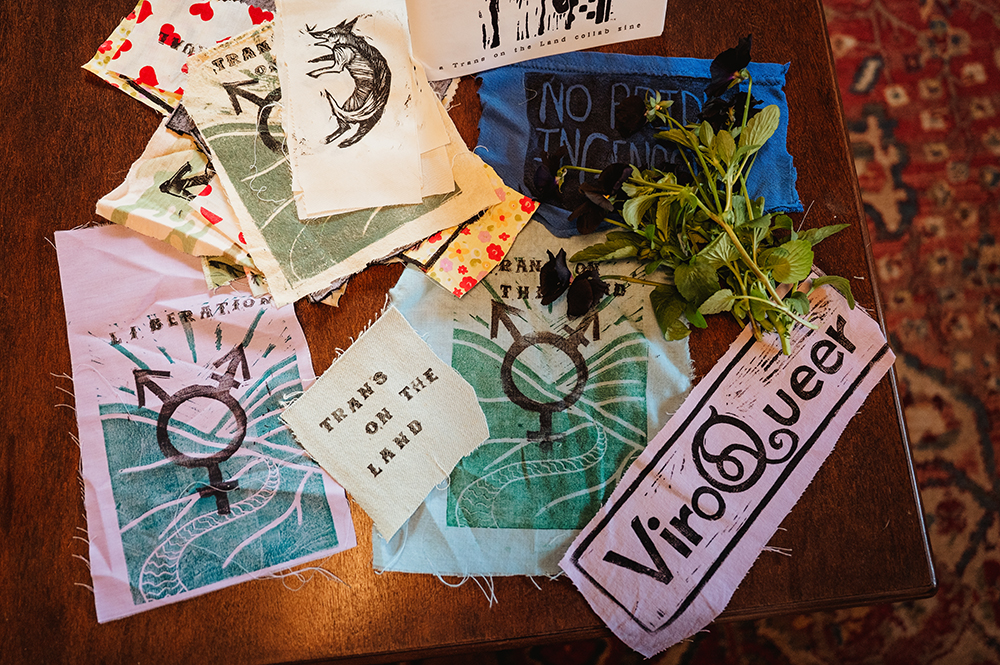
Trans on the Land was co-created by Hawthorn McCracken and Murray Valentine to create a network for trans and non-binary folks in the Driftless Area to learn about foraging, farming, and food preservation. Since the start, it’s evolved into a social club with a shared interest and passion for the land. A quarter of the members are actively farming or managing land. The group acknowledges that the Ho-Chunk Nation are the true owners of the land in the Driftless Area. Our Lives sat down with Hawthorn McCracken and Rufus Jupiter to learn about Trans on the Land.
Why did you form Trans on the Land & when?
Hawthorn: I am a goober. I make friends as an adult by starting a group. I have a trail of other social organizations behind me. This group started online in 2020. Our first in-person gathering was a walk through the Kickapoo Valley Reserve. I had attended events at Soil Sisters (Wisconsin) and Queer Farm Conversion in Iowa, and although both groups were welcoming, I didn’t feel like I truly belonged or that anyone understood my identity. But I loved their model of hosting skill shares and teaching people how to navigate the world of farming and facilitate friendships.
Rufus: One thing I’ve noticed is new people are moving to this area because there’s a shared love of the land itself. Some live in town or outside of town, but we all have a shared value of caring for this particular land.


How many people are in this group?
Hawthorn: There are about 150 people on the email listserv, including people from Milwaukee and Madison who dream of living in the Driftless Area. Between 24 to 30 people meet regularly. They live in La Crosse to Viroqua and even Decorah, Iowa.
What types of activities do you do?
Hawthorn: The activities are driven by the group’s and individuals’ interests and needs. We’ve inoculated mushroom blocks on straw and wood, removed garlic mustard and other invasives from someone’s land, and planted native species. Originally, I planned that we would go on two foraging walks per month and do skill share potlucks at members’ houses, but it’s less formal now. If someone wants to host something on their land they do, with art meet-ups and swimming in natural areas thrown in.
Tell me more about the Driftless Dream Zine.
Murray Valentine: It shares art and writing from 18 trans and queer contributors, most of whom are either from or living in Wisconsin, Minnesota, and Iowa. The prompts for the latest issue were, “What kind of community do you long for? Do you know what it feels like? How do the local ecology and your identity shape these dreams?” The contributions are interesting, thoughtful, strange, funny, heartfelt, curious, hopeful, melancholic, joyful, playful, and revolutionary. I’m extraordinarily proud of the writing, art, and the final product. A lot of work and care went into it. We gave out 50 or so copies at Viroqua Pride and you can check out copies at the UW–LaCrosse Library. We have plans to print more in the near future, and there is a full-color PDF and printable black-and-white version available for free on the Trans on the Land Linktree on Instagram page.
Does this group fulfill a unique purpose?
Hawthorn: We’re not a nonprofit, we’re not a political action organization, but in our steering meetings we ask, “What do folks need from Trans on the Land emotionally, physically, artistically, and how are we meeting those needs?” One thing that’s come out of national uncertainty is resiliency organizing—talking about how we’re moving forward as a group that provides resiliency in the face of national uncertainty about the future and natural disasters like floods and fires. We’ve also done things like meal trains to support each other through health issues.
Rufus: The future is tenuous right now, and we’re rural. We need to make sure a safety net is in place. We’re not all in proximity to each other; we’re all over the place in the hills. It’s important to stay in contact with each other as a group, as a network.
How do you weave trans identity & farming?
Rufus: I own several acres of land and had a fresh flower business. Trying to navigate the farming world as a queer person felt lonely. I look around, and I don’t see other people like me doing this. I feel like I stick out. I feel like I have to do a lot of masking. I felt myself wanting to be more macho to pass as a more masculine-perceived person, especially around someone I didn’t already know. In general in rural life, even in Viroqua, you still don’t know who you’re encountering when you’re out in public. I feel very guarded.
Hawthorn: The loneliness of not seeing yourself in the space was a huge motivator for creating this group. There have been increased political attacks on trans youth, and representation is so important to combat that. As someone who grew up in the Bible Belt, for the longest time I thought I had to move away to be myself. Trans people are out here in rural areas and living good lives. I want to show queer and trans youth in a rural area what’s possible. If you want to be in 4-H and be trans, you can. We’re supporting friends in the community with trans kids. It’s becoming a big part of what we do as a group.
Rural communities have been gutted, so there’s a lot of attention on revitalizing rural areas. You don’t have to go to Madison or the Twin Cities to do cool shit.
Rufus: Jack Halberstam coined the term “metronormativity.” There’s this idea that queerness belongs in large metro areas and doesn’t belong anywhere else.
Hawthorn: Being in a group specifically for trans, non-binary, non-gender-confirming people, there are so many shared insights. We are on the same wavelength of queering, and that influences our approach to community building. If you live in the Driftless Area and want to join us, do it. If you want a group like this in your area, build it.
Trans on the Land is transforming both lives and the rural landscape. By community building and physically removing invasive species, they are able to heal the land and each other. Follow them at @transontheland.





0 Comments