


|
Getting your Trinity Audio player ready...
|
There comes a moment in leadership when you realize you have been explaining yourself more than exercising your authority.
You recognize that you have been negotiating your dignity in rooms that benefit from your brilliance but hesitate to affirm your power. You see clearly that you have been invited into conversations that you helped design, yet your presence is treated as optional.
Black History Month demands more than remembrance. It demands correction. And that correction must be heard clearly by local and state leaders across Wisconsin.
There is a version of history that is comfortable. It highlights familiar names, repeats safe narratives and avoids structural truth. Then there is the full record. The full record includes Black LGBTQIA+ people whose fingerprints are on every major movement for freedom in this country.
Without Black gay leaders, there would be no modern LGBTQIA+ movement.
This is not exaggeration. It is historical reality.




The uprising at Stonewall was not ignited by institutions seeking approval. It was catalyzed by Black and Brown queer and trans people who were already accustomed to surveillance, criminalization and erasure. The modern LGBTQIA+ movement was born from the courage of people society deemed disposable.
If we move from the streets into the legal foundation of this nation, we encounter Pauli Murray. Before landmark civil rights cases reached the Supreme Court, Murray was constructing constitutional arguments against segregation. Thurgood Marshall’s legal team relied on Murray’s scholarship. Years later, Ruth Bader Ginsburg credited Murray’s reasoning in cases challenging sex discrimination.
The legal scaffolding that dismantled segregation and redefined equality bears the imprint of a Black queer intellectual. Pauli Murray was not an intersection between movements. Murray was an architect of them.
Yet Murray is rarely centered in public narratives. That omission is not accidental. America has long been uncomfortable with leaders who refuse to fragment themselves for public comfort: Black. Brilliant. Queer. Uncompromising.
Murray forced movements to expand their frameworks rather than asking individuals to shrink.
Local and state leaders in Wisconsin must ask themselves an honest question: When you speak about civil rights history, do you tell the full truth? When you reference equality, do you acknowledge Black queer architects who built the legal and cultural frameworks you now inherit?
During Black History Month, we often hear a familiar refrain. Black history and LGBTQIA+ history are described as equally important because they highlight the diverse experiences and struggles of marginalized communities. We are told they are not the same, but both are vital.
The first part of that statement is true. Both histories are vital. The second part requires precision.
Black history is not simply the story of one marginalized community among many. Black history is the structural history around which the United States was built.
The American economy was constructed through the forced labor of enslaved Africans. The Constitution itself contains compromises rooted in slavery, including the Three-Fifths Compromise and the Fugitive Slave Clause. The Civil War, Reconstruction amendments, Jim Crow laws, redlining, mass incarceration and modern voting rights battles were all direct responses to Black existence in this nation. Black history shaped federal and state law, economic systems, land ownership, education policy, housing markets and criminal justice frameworks.
There is no American history without Black history because Black people were central to the nation’s economic and constitutional development from its inception.
LGBTQIA+ history, while deeply significant, did not structure the original economic and constitutional framework of the United States. Anti-LGBTQIA+ discrimination has caused profound harm, but it did not define the founding compromises of the nation, the construction of its labor system or the primary economic engine that built its wealth.
This is not a competition of suffering. It is a matter of structural origin and national formation.
Black history is foundational. LGBTQIA+ history developed within that foundation. When local school districts, municipal governments, state agencies and nonprofit institutions treat these histories as interchangeable diversity narratives, they flatten structural reality.
They convert Black history from a constitutional and economic cornerstone into one awareness category among many. That shift may feel inclusive, but it erases scale, impact and historical architecture.
For Black LGBTQIA+ people, this clarity is essential. Our queerness exists inside a racial structure that predates modern LGBTQIA+ identity politics. Anti-Blackness is woven into the legal and economic architecture of this country. That is the framework within which all other struggles operate.
Understanding that reality does not diminish LGBTQIA+ history. It strengthens our collective understanding of power and responsibility.
Across Wisconsin, this misunderstanding has consequences.
Local governments form diversity councils yet fail to fund Black-led initiatives proportionate to need. State agencies create equity task forces yet overlook Black LGBTQIA+ leaders who have been doing the work for decades. Boards remove Black gay leaders from tables we helped design, then bring in consultants from other states to perform work that local experts are fully capable of leading.
To local elected officials — mayors, council members, county executives and school board leaders — this must be addressed directly. Stop treating Black gay leadership as symbolic representation. Stop calling in experts from outside Wisconsin to solve challenges that Black leaders here already understand intimately.
Invest in the intellect and infrastructure that already exists within our communities.
To state legislators, agency heads and statewide decision-makers, accountability must be more than a press release. Investment patterns reveal priorities. Appointment decisions reveal values. If Black-led organizations continue to receive a fraction of statewide resources while bearing a disproportionate burden of inequity, that is not accidental. That is a policy choice.
Wisconsin does not lack Black intellect. Wisconsin does not lack Black strategy. Wisconsin does not lack Black gay leadership capacity.
We have the credentials. We have the policy expertise. We have the lived experience. We have the community trust. Yet too often we are consulted rather than empowered, invited rather than entrusted, highlighted rather than funded.
That is not equity. That is containment. Black gay leaders are not supplemental voices in justice work. We are architects of it.
Pauli Murray did not wait for validation before drafting arguments that reshaped constitutional law. Murray built the intellectual foundation that others later stood upon. That is the inheritance Black leaders across Wisconsin carry today.
We understand systems because we have survived multiple layers of exclusion within them. That lived clarity produces strategic leadership. It produces resilience. It produces vision.
As a Black gay leader in this state, I refuse symbolic inclusion in place of structural authority. My Blackness is not negotiable. My queerness is not an accessory. My leadership is not conditional upon comfort.
Local and state leaders must recognize this moment clearly. Black History Month is not ceremonial. It is structural. It is a reminder that this nation and this state were built in direct relationship to Black existence. That truth requires proportional investment, proportional power and proportional recognition.
To communities across Wisconsin: Honor LGBTQIA+ history fully. But do not dilute Black history in the name of balance. Do not flatten structural truth for the sake of comfort. Anti-Blackness shaped the foundation of this country and continues to shape its systems in ways that are historically distinct.
Acknowledging that reality does not weaken solidarity. It clarifies responsibility.
Invisible no more.





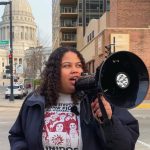





Great and powerful statement that deserves sharing, even outside of Wisconsin! Glad to have Ritchie’s leadership in Milwaukee!