


|
Getting your Trinity Audio player ready...
|
We’ve come to the conclusion that we are now officially semi-coastal, with a home here in Madison, an apartment in Manhattan, and an interior and furniture design business that swings both ways. After having been known solely as Shaver/Melahn Studios for so long we are also becoming comfortable with our new business’s moniker: Pleasant Living.
My connection to Madison goes back all the way to a time when St. Mary’s on Park Street was known as the “Mother and Baby Hospital.” Having been born there it gives me the ability to call myself a native Madisonian. Rick, on the other hand, is relatively new to the area as his roots were planted in Georgia soil, and he has lived most of his life in New York City. Most relationships are a combination of opposites attracting, and ours has been no different. Growing up gay during the later half of the twentieth century, no matter where you were geographically, gave many of us wanderlust that frequently resulted in a need for a change of scenery in order to come out and come to terms with our sexuality.




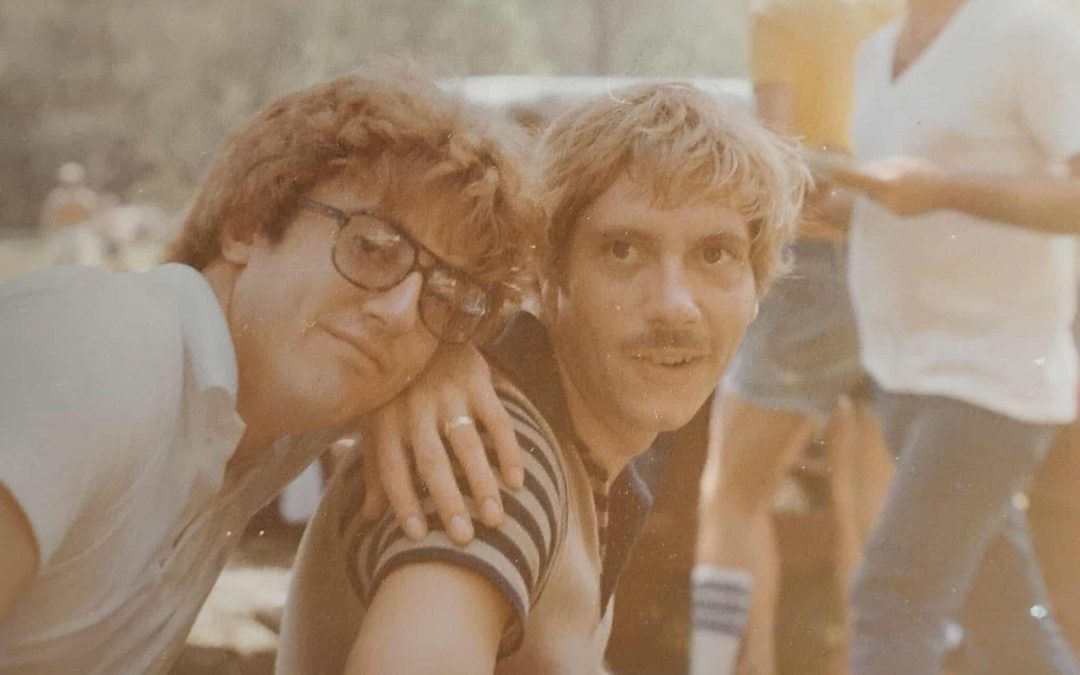
The magnets that drew most of us were the big cities that were more tolerant and accepting of alternate lifestyles. Both Rick and I had our journeys end in New York where, on a snowy night in January, 1979, we found each other on a dance floor at the Ice Palace, a gay disco in the basement of a building around the corner from Carnegie Hall. At the time, I was an associate professor in the Pre-Design Department at Kansas State University, and Rick was a freelance job manager in the industrial show business arena. After that night on the dance floor it was another six months before I could come back to Manhattan.
Joining forces at home and at work
We joined forces in a relationship that was both personal and professional, eventually moving in together and opening our own design firm specializing in multi-media productions for such clients as Avon, Architectural Digest, Ralph Lauren, The Italian Trade Commission, and Johnson & Johnson. These were corporate events along the lines of music videos, creating multi-disciplinary presentations requiring talent, celebrity coordination, and sets that rivaled Broadway productions.
After a decade of this for me, and for Rick more than 15 years, the toll of having to work more all-nighters than we could count forced us to recalculate our career decision. Rick took the lead. We were still young enough that the risks of a new direction weren’t as daunting as they would be later in life. I had always taken the creative approach to life and career. Rick had a more business and organizational path. It wasn’t a conscious decision, but I stayed more with keeping the design firm moving while Rick began exploring other avenues that were more stimulating and creative.
Rick has always been an amazing cook, and all our friends and I have been the beneficiaries of the meals he’s prepared. It was after a trip to Europe, where we put together a food connoisseurs journey of visiting the major chefs of France, that he took up some serious cooking classes. He attended the Peter Kump New York Cooking School, which later became the Institute of Culinary Education, and quickly rose to become the sous chef for Peter Kump, a Julia Child and James Beard protegé. Realizing that the hours and demands of a career in the restaurant industry were no better and conceivably worse than the production hours he was looking to get away from, Rick turned the page on cooking and yet again started looking elsewhere.
Changing and growing together
It was on another winter evening while sitting in bed and discussing our future that we decided to play a game that would profoundly affect our future. We were each to write down what we thought the other’s strengths were and what we could see as an alternate occupational path. I had written down interior design as a new career that would unleash Rick’s creativity and feed his passion. He had already shown signs of his talent in the work we had done on our Brooklyn apartment and our weekend home in the Catskills. Within the year he had enrolled at the New York School of Interior Design. By the time he graduated as valedictorian of his class he had already amassed a clientele from the contacts we had made from our design business, including the CEOs of major advertising and financial firms throughout Manhattan.
Our offices in Chelsea were now a multi-dimensional firm where we continued to work with our industrial show business clients, providing them with branding, multi-media productions and graphic design, and so we added interior design to the mix. Even as we added more diversity to our portfolio we intentionally wanted to keep our status as a boutique design firm. Within a short time of adding the interior design division to our firm, Rick was named one of New York’s top 100 designers by Gotham Magazine and his work started appearing in shelter magazines like House Beautiful, Old House Journal, Metropolitan Home and New York Spaces.
Building a family
With the success of our business, we were able to focus a bit more on our personal relationship goals. It was now the mid-1990s. I had always dreamed of a family that included more than the two of us and a dog (the dog was Rick’s concession to me while he got the house in the country). Whenever I brought up the idea of adoption he wasn’t interested—it was too laden with a very high possibility of rejection. At that time, adoption by a gay couple was more dream than reality.
It wasn’t until his mother became ill and passed away that his whole idea of family changed. I started the research, going to meetings with other gay men who wanted to start a family. What I heard was mostly negative, the options involving either deceit and lying or fostering older children or children with disabilities. We were referred to a lawyer who dealt with gay issues and had helped with a few adoptions. It wasn’t long before we found ourselves working with an adoption broker who guaranteed us anything we wanted for an escalating price with every anomaly we put into the request. In 1994 any request from two men automatically raised the entry fee. We knew, even though the broker’s client list included some very powerful people, this wasn’t a direction we wanted to pursue.
Months later we were connected with a lawyer whose specialty was adoption. Susanne guided us through the process, reassuring us that the only people who didn’t succeed were the ones who didn’t get back on the horse after failing on their initial attempts. We were convinced and Susanne agreed that we needed to approach adoption with honesty. We ran our ads as two men looking to be parents. There were responses that were not only devastating but also viciously nasty.
Eventually we found a birth mother unintimidated by our situation. In July 1996 we got the call to come to Texas where, on the morning of July 3, in a hospital delivery room we helped push and comfort the birth mother as we watched Emmy swim out into the world. With tears streaming down his cheeks Rick asked the attending nurse if he could hold her. The nurse looked at him with kindness and said, “Of course, she’s your daughter.”
Challenges of a changing world
Emmy’s first day of kindergarten was on a Monday. Her kindergarten class had been split in two with her half going on that Monday and the second half going on the following Tuesday. That Tuesday was a clear September day. It was my sister who called that morning asking if we had the TV on. It was there that I became aware that the North Tower had been hit by a plane. In horror, our nanny and I with Emmy in our arms ran to the top of our apartment building, a block and half from the Empire State Building, and watched as the towers came tumbling down. Rick had already set off for our Chelsea offices and from the street witnessed the second tower being struck. With no one knowing if there were still planes out there and if the Empire State Building might be another target we abandoned our apartment and went to the office. Within hours we left for our home in the Catskills not knowing how many of Emmy’s classmate’s parents might not be there to pick them up from their first day of school.
Our business and our lives changed dramatically after 9/11. My part of the business immediately dried up as corporations were no longer willing to put their employees on planes for around the world incentive trips, new product introductions or annual corporate meetings; the kinds of meetings that we had been designing and producing. Our predominant focus eventually switched to becoming an interior design business.
Rick had always had a passion for furniture and furniture design. With the success of the interior design portion of our business he was able to add furniture design as a new development to our firm. In 1998, we launched our first small furniture collection as a bench made line available to designers and architects through showrooms throughout the continental United States. The line took its direction from the clean lines of the French Moderne movement and became a success, with pieces now a part of the Library at Stanford University, various major hotel lobbies, and in the personal residence at the Clinton Library.
Our success continued until a perfect storm of illness and the economic crisis of 2008/2009 tore apart our industry and our personal situation. Failure sometimes is the best route to finding out what you’ve learned and whether you can survive the future. Starting over is what we’ve done.
Another fresh start
We’re now one of 30 designers selected by the New York Design Center to be represented through their Access to Design collective, we’ve paired up with Black Wolf Designs, a Wisconsin furniture manufacturer, on prototyping another three lines of furniture, and we were selected by Sony to design their offices for a new division in Noho, in lower Manhattan.
We continue to work with residential clients in New York, New Jersey, Florida and Wisconsin where our design philosophy continues to focus on the client. We want our designs to reflect our clients’ lifestyles and not a preconceived solution. It’s one thing to design a beautiful space, but the ultimate measure of good design is how well the design actually “works.”
The design industry is a tricky business; it’s looked on as a luxury by many and a necessity by some. We always encourage our clients to do their research, and with our help formulate an entire plan, breaking down their project into phases when necessary. After the project parameters have been established we then help them find their comfort zone, design a space unique to their vision and help them understand what is a realistic budget and time frame for completion.
We’re hand-holders, design experts, confidants and frequently friends. Our biggest compliment is the repeat client. Our greatest joy is being able to follow our passion in a profession that fills our cup to overflowing.












0 Comments